


In recent years, the Western design world has been captivated by a "revolutionary" new field of study: Neuroarchitecture. Contemporary architects, neuroscientists, and interior designers are converging to study how the geometry, lighting, elemental balance, and spatial arrangement of a building directly impact human cognition, emotional well-being, and physiological health.
In Western academia, this is lauded as a groundbreaking, modern discovery. Yet, for those deeply rooted in the ancient wisdom of the Indian subcontinent, this is not a new frontier at all. It is merely a primitive, fragmented re-interpretation of the ultimate, original science of space—Vastu Shastra.
At its core, Vastu Shastra is far more than the superstitious placement of doors and water bodies; which is nothing but a reductionist view, unfortunately propagated by modern quacks and frauds.
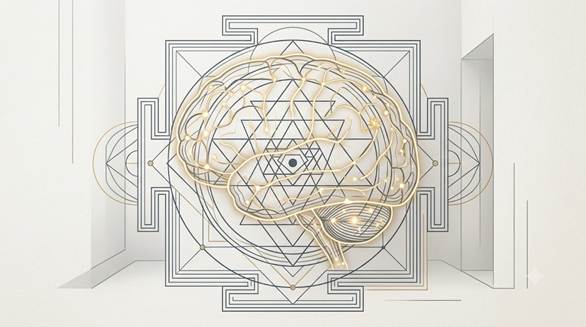 True Scientific and Vedic Vaastu is an intricate, highly evolved discipline rooted in advanced geometry, mathematics, astronomy, and an acute understanding of the Earth’s magnetic and solar grids. Thousands of years before Western science began measuring cortisol levels in poorly lit rooms, Vedic seers had already mapped the precise psychophysiological effects of directional alignments and spatial proportions on the human nervous system.
Modern Neuroarchitecture is merely scratching the surface of what Vastu Shastra codified millennia ago in complex treatises like the Manasara, Mayamata, and the Vishwakarma Prakash.
However, there is a profound and deeply unfortunate irony in how this knowledge is treated today, particularly within its homeland -
Many modern Indian architects, builders, and interior designers are quick to dismiss Vastu Shastra as archaic dogma or religious superstition simply because it carries the "Vedic" label. Yet, the moment a Western researcher publishes a paper on "Neuroarchitecture," confirming that a space's proportional geometry affects spatial cognition and human well-being, these same professionals will herald it as undeniable science.
This is the tragic hallmark of an intellectual colonial hangover; A systemic conditioning where indigenous brilliance is invalidated until it is repackaged, stripped of its cultural origins, and stamped with Western approval. An architect in India might scoff at the mention of the Brahmasthan (the vital energy center of a built space), but will eagerly attend a seminar on how central spatial voids improve cognitive flow and mental tranquility in modern office design.
This widespread skepticism among contemporary professionals is not entirely unprompted, but it is deeply misplaced. It is true that finding authentic, unbroken texts on the empirical data of Vastu can be challenging today. However, this is not because the science lacked empirical backing; rather, it is a historical reality that India's ancient universities, libraries, and temples—which housed meticulously documented research and mathematical proofs of these sciences—were systematically destroyed by foreign invaders over centuries. The profound knowledge of Vastu Shastra survived primarily through word-of-mouth traditions and deeply guarded lineage transmissions. Over generations, the complex "why" was often lost, leaving only the "what," which allowed modern skeptics to mistake profound scientific and geometrical guidelines for baseless religious rituals.
Where neuroarchitecture relies on fMRI machines to observe how the human brain reacts to a sharp corner versus a curved arch, Vastu Shastra approaches the human body as an extension of the cosmic macrocosm ("Yatha Pinde Tatha Brahmande"—as is the microcosm, so is the macrocosm).
The layout of a structure, dictated by the Vastu Purusha Mandala, is an exact mathematical grid that aligns the building's electromagnetic frequencies with human bio-rhythms.
It isn't just about aesthetics; it is about resonance.
When an interior design perfectly aligns with these geometric and geographic realities, the human mind enters a state of natural homeostasis, reducing stress and enhancing cognitive function—the exact goal neuroarchitecture is blindly striving toward.
For the contemporary world, the true application of Vastu Shastra does not require sacrificing modern aesthetics or living in antiquated structures. Premium interior design and Vedic Vaastu are perfectly synergistic.
A true Vaastu consultation does not demand tearing down walls unnecessarily or placing arbitrary symbols and pyramids in every corner. Instead, it utilizes the principles of subtle energies, elemental balance, and precise mathematical proportions to create spaces that heal, inspire, and elevate consciousness. Whether it is a corporate headquarters designed to foster focus or a luxury home built for tranquility, the laws of spatial harmony remain absolute.
At Vaastu Devayah Namah, our mission is to resurrect the authentic, Scientific, and Vedic essence of Vastu Shastra. We strip away the myths, the fear-mongering, and the superficial remedies, presenting Vastu as the highly evolved architectural and neuro-spatial science it truly is. We bridge the gap between ancient Vedic wisdom and contemporary interior design, ensuring that our clients experience the profound benefits of a perfectly balanced space.
As the modern world slowly awakens to the realities of "neuroarchitecture," we stand firmly on the foundation of the original, ultimate science of the built environment.
If you are looking to harmonize your living or working space with the fundamental laws of nature, geometry, and human consciousness, it is time to look beyond passing Western trends. Book a professional Vaastu consultation with us at vaastudevayah.com, and experience the transformative power of authentic Vaastu Shastra for yourself.